MINING AND INDUSTRIAL COMPLEX PIJACAL WITH MINING TOWER "ŠOHT"
The term Pijacal refers to the entire mining and industrial zone. The Pijacal area includes all the premises necessary for the maintenance of mining machines, in the form of a series of mechanical, electrical, carpentry, and other workshops in which all the machines and tools used in the mine were repaired. In addition, spacious warehouses and a chemical laboratory were stationed there. Right at the entrance to the market was a scale for measuring the weight of empty and full transport vehicles. A little further on, a heating plant was built with two powerful boilers for heating water for the needs of the mine and the needs of the mining settlement. To the east of the heating plant is a tall building with a rectangular floor plan, made of brick and with reinforced concrete belts, in which was a large export machine with two huge drums on which steel cables for raising or lowering the cave lift were almost constantly wound. On the southeast side, on the edge of the Pijacal, is a large elongated rectangular building in which extremely powerful compressors operated continuously, producing large amounts of compressed air needed to operate almost all the machines in the mine. After the closure of Jama Labin, the power plant on Pijacal began to collapse. At the time of privatization, these buildings landed in private hands, so various entrepreneurs gave these facilities a new function. Pijacal is a cultural monument and is entered in the national register, which means that future interventions or changes will be coordinated by the competent conservation department for the protection of cultural monuments.
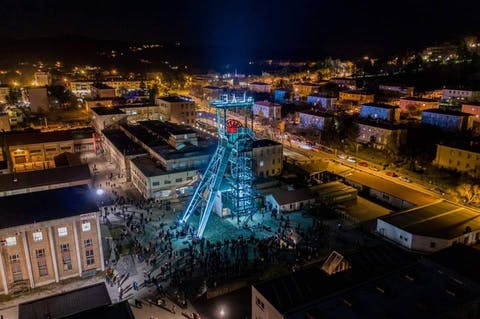 Today,
Šoht is one of the most beautiful monuments of the rich mining past of
the Labin area. Šoht is a tall steel tower that over the years has become
a symbol of Labin and its inhabitants. Šoht started operating in 1940,
when production began in the Labin Pit. At its top it has two very large wheels
which moved in synchrony, with one moving forward, and the other backward, and
thus raised or lowered the lift cages. The cages, with three levels, transported
miners (16 in each cage at each level), full or empty wagons and various other
material. The vertical shaft guides were made of a special wood (larch) which
proved to be the safest in the event of stopping the lift. The lift rope, made
up of interwoven steel threads, was inspected and lubricated daily. The height
of the tower is 30.93 meters, and the depth of the vertical shaft is 570 m.
Today,
Šoht is one of the most beautiful monuments of the rich mining past of
the Labin area. Šoht is a tall steel tower that over the years has become
a symbol of Labin and its inhabitants. Šoht started operating in 1940,
when production began in the Labin Pit. At its top it has two very large wheels
which moved in synchrony, with one moving forward, and the other backward, and
thus raised or lowered the lift cages. The cages, with three levels, transported
miners (16 in each cage at each level), full or empty wagons and various other
material. The vertical shaft guides were made of a special wood (larch) which
proved to be the safest in the event of stopping the lift. The lift rope, made
up of interwoven steel threads, was inspected and lubricated daily. The height
of the tower is 30.93 meters, and the depth of the vertical shaft is 570 m.



To add this web app to your homescreen, click on the "Share" icon

Then click on "Add to Home"

To add this web app to your homescreen, click on the "Share" icon
Then click on "Add to Home"
It looks like your browser doesn't natively support "Add To Homescreen", or you have disabled it (or maybe you have already added this web app to your applications?)
In any case, please check your browser options and information, thanks!
It looks like your browser doesn't natively support "Add To Homescreen", or you have disabled it (or maybe you have already added this web app to your applications?)
In any case, please check your browser options and information, thanks!